What Is Wheel Offset?
A set of wheels can look perfect online and still rub the fender liner on the first hard turn out of the driveway. The gap between how wheels look in photos and how they fit on your vehicle usually comes down to one number most buyers skip: offset.
Offset is the distance in millimeters between the wheel’s centerline and its hub mounting surface, the flat face that bolts against your hub. That single measurement decides where the wheel and tire sit inside the wheel well: tucked inward toward the struts and control arms, or pushed outward toward the fender lip.
That’s why it pays to have wheel offset explained before you buy custom or replacement wheels, not after they’re mounted.
Positive vs. Negative vs. Zero Offset
All three describe the same thing: where the mounting surface sits relative to the wheel’s centerline.
- Positive offset means the mounting surface sits toward the outer face of the wheel. The wheel tucks inward, closer to the suspension.
- Zero offset means the mounting surface sits exactly on the centerline, with the wheel split evenly inboard and outboard.
- Negative offset means the mounting surface sits toward the back of the wheel. The wheel pushes outward, toward the fender. This is what creates the deep-dish look and wider stance popular on lifted trucks.
Positive vs negative wheel offset is easier to compare once you know how it’s marked. Offset is usually stamped or cast on the back of the spokes or the inner barrel. You’ll see something like ET35 or +35, both meaning a positive 35 mm offset. A minus sign, like ET-12, means negative offset. If you’re comparing new wheels to your factory set, that stamped number is the first thing to find.
Backspacing vs. Offset: Two Ways to Measure the Same Space
Wheel sellers use both numbers, and they’re not interchangeable. Backspacing is measured in inches from the hub mounting surface to the inner edge of the wheel. Offset is measured in millimeters from the centerline.
The practical difference: offset tells you where the wheel sits relative to center, which mostly affects how far the tire pokes toward the fender. Backspacing tells you how much room is left on the inside, between the wheel and your struts, control arms, brake calipers and tie rods. Two wheels can share the same offset and have different backspacing if their widths differ, and one of them may hit your suspension.
So the backspacing vs offset question doesn’t have a single answer. You need both numbers plus the wheel width. For quick conversions, 10 mm of offset is about 0.39 inch, enough to move a tire noticeably closer to a fender lip.
Why Width and Offset Have to Be Read Together
Offset alone can’t tell you how wheel offset affects fitment, because width changes the math.
Keep the same offset and go 1 inch wider. That extra inch splits evenly around the centerline: about 0.5 inch more wheel on the outside and about 0.5 inch more on the inside. The offset number didn’t change, but both edges of the wheel moved.
The outside half is the one most buyers watch, because that’s where poke and fender clearance live. The inside half is the trap. A wider wheel at the “same” offset reaches further toward the strut, upper control arm or brake caliper, and that contact happens where you can’t see it from the curb.
A wheel offset calculator or the Comtires wheel configurator is a good way to narrow the options. Treat the result as a shortlist, then confirm the fit on the actual vehicle, with its actual suspension and tire size.
How Offset Changes Steering Feel
Offset doesn’t just move the tire. It changes the geometry your steering works against.
According to Empire Tire & Wheel, moving a wheel outward alters scrub radius, the relationship between the steering axis and the tire’s contact patch. When those two are close, the tire pivots almost in place as you steer. Push the wheel outward and the tire has to sweep through a wider arc.
Empire Tire & Wheel lists the effects drivers may notice: heavier steering, kickback through the wheel over bumps, and tramlining, where the vehicle follows grooves in worn pavement instead of tracking straight, something you’ll notice on grooved freeway lanes. How much shows up depends on the vehicle, the tires, the alignment and how far you’ve moved from the factory offset.
Tire Rub and Other Signs the Offset Is Wrong
Wheel offset and tire rub go together, and rubbing rarely shows up in the parking lot where the wheels were installed. It appears at full steering lock, over dips and speed bumps when the suspension compresses, or with passengers and cargo on board. Watch for:
Scuffing or chirping from the fender liner at full lock
Rub marks or torn plastic on the inner liner
Scraped spots on a strut, control arm or tie rod
Contact that only happens over bumps
Uneven tire wear is another signal. If the wear pattern looks different after a wheel change, have the alignment checked. Hard contact or a pothole strike can also damage the wheel itself, so it’s worth knowing the signs of a bent or cracked rim if vibration or air loss follows.
Lifted Trucks and Leveling Kits
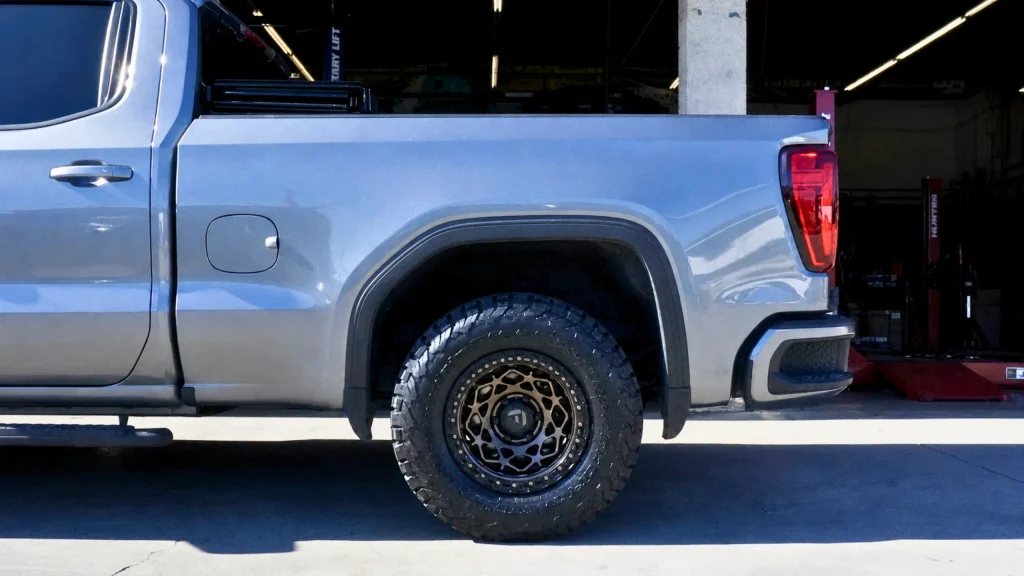
Wheel offset for lifted trucks is where the stakes are highest, because two things change at once. Owners running a lift or leveling kit often choose a lower offset, pushing wheels outward to fill the opened-up wheel wells and to gain room between a larger tire and the suspension.
The catch is that a bigger tire and a lower offset change clearance in different directions. A lower offset gives you inner room but spends it on the outside, closer to the fender. Stack an aggressive tire size on an aggressive offset and the combination can rub even though each choice looked reasonable on its own.
There are no universal numbers here. The right combination depends on the lift height, suspension design, tire size and vehicle. If you’re planning a lift or leveling kit, have the wheel and tire package checked against that specific build before you order.
The Bottom Line
Offset is a position. It’s the millimeter distance between the wheel’s centerline and the hub mounting surface, and it decides whether the tire sits toward the suspension or the fender.
Positive tucks in, negative pushes out. The stamped ET number on the back of the wheel tells you which one you have.
Backspacing covers the inside. Measured in inches from the mounting surface to the inner edge, it tells you whether the wheel clears your suspension.
Width changes the math. One inch wider at the same offset adds about 0.5 inch on each side, including the side you can’t see.
Steering feel is part of the trade. Moving wheels outward changes scrub radius, which can mean heavier steering, kickback and tramlining.
For how wheels and tires work together, see The Ultimate Guide to Tires.
Get Your Wheel Fitment Checked in Ontario, CA
Online tools and offset calculators are a good starting point. What they can’t see is the tires already on your vehicle, the lift or leveling kit under it, or the brake and suspension hardware that varies between trims of the same model. A technician looking at the vehicle can catch an inner-clearance problem before you’ve paid for wheels that don’t fit.
Comtires installs custom wheels and lift and leveling kits for Inland Empire drivers. Call us or come in with the wheel specs you’re considering, and a technician can check them against your vehicle before you buy.